08/11/2026
Best Label Solutions for Beekeepers in 2026
When Labels Face Their Toughest Test
A honey jar label often faces its greatest challenges after leaving the producer's workshop. It goes into the refrigerator, gets grabbed with damp hands, travels in boxes, and sometimes ends up in gift baskets. The best label solutions for beekeepers aren't just beautiful—they're highly readable, adhere properly, and maintain a sense of quality throughout the product's use. A good label helps distinguish acacia, rapeseed, linden, or wildflower honey while making the producer's brand visible. With small batches, it's especially important not to have to order unnecessarily large quantities, yet the same design should be reorderable for future expansion. Your decision depends on the bottle shape, storage conditions, and sales method.
What Makes a Label Suitable for Honey Jars?
Honey itself doesn't soak through labels, but the product's environment presents many challenges. Condensation forming on a jar removed from the refrigerator, stickiness around the cap, friction during shipping, and sunlight can all leave visible marks on inferior materials. At farmers' markets, labels pass through many hands, so durability is just as practical a consideration as the graphic design.
Paper labels might work well for dry products stored briefly or for a rustic aesthetic. For honey jars, however, vinyl-based adhesive labels are often the safer choice. They're waterproof, better tolerate moisture and handling, and with the right ink, colors remain vibrant longer. If bottles regularly go into refrigerators or the labeled product reaches customers through parcel services, this difference quickly pays for itself.
Glossy or Matte Finish?
Glossy vinyl offers intense colors and strong contrast. It works well for vibrant, modern honey brands, especially when the label features food photography, detailed illustrations, or gold-colored graphic elements. It's eye-catching on shelves, though it can glare in strong light.
Matte finish feels more understated and premium. It suits artisanal, nature-oriented branding particularly well, fine line drawings, and labels with lots of back-side text. Fingerprints are less visible on it, making it practical for gift packages and direct producer sales. Lamination provides additional protection against scratching and moisture. While not mandatory for every label, it's worth considering for premium product lines, frequent cold storage, or heavy shipping demands. When deciding, consider not just the per-unit price, but also the risk of defective, curled, or damaged labels arriving.
Best Label Solutions by Bottle Shape
Label size isn't purely a design question. Too-wide stickers wrinkle on narrow, curved bottles; too-small ones don't leave enough space for mandatory and brand-building information. Before placing an order, measure the bottle's straight or gently curved section where the label will go.
Traditional Cylindrical Bottles
Rectangles or rounded-corner rectangles work well on conventional cylindrical bottles. This is the most efficient shape when lots of information must fit: product name, net weight, producer details, origin, best-before date, and batch identifier. Rounded corners are less prone to peeling than sharp corners, especially with damp use.
Hexagonal Bottles
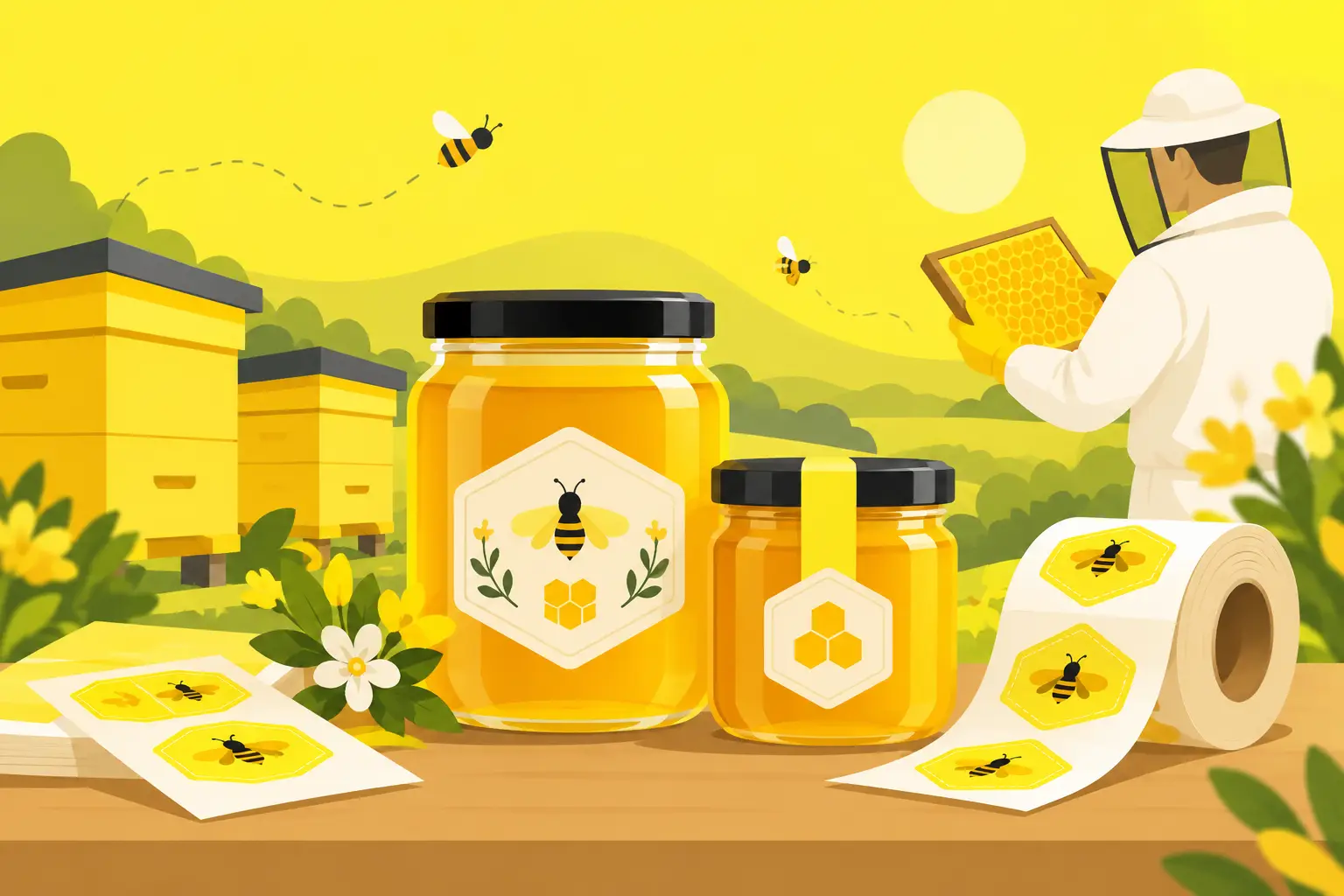
Hexagonal bottles allow a dedicated brand label on the front and an informational label on another side. This solution looks more organized and makes handling variable data easier. If the honey type or harvest year changes seasonally, you don't need a completely new main label each time.
Small Tasting or Gift Bottles
On smaller 40–125 gram bottles, overcrowding is the most common mistake. A well-readable front label plus a small back or bottom informational sticker works better here. At first glance, customers should see what honey they're holding, who it's from, and the size of the package.
Information That Can't Be Missing
Label design works well when customers quickly understand it. The product name should be prominent, and the honey type shouldn't get lost among brand names or decorative elements. Claims like "producer," "raw," or "creamed honey" should only appear if they accurately describe the product's actual properties.
Food labeling regulations can change, so it's worth checking current requirements before sending to print. Generally, you'll need the name, net quantity, best-before date, batch identifier, storage recommendations, origin information, and responsible food business details. If honey comes from multiple countries, special marking rules may apply.
Variable data doesn't necessarily have to print with the full color label every time. Many producers use pre-made brand labels and add the date and batch number on a separate small label or printed marking. This reduces inventory risk, especially when different honey types are produced in varying quantities.
Design With Printing in Mind
A label always looks bigger on screen than it does on a 250-gram jar. That's why it's worth checking the smallest text sizes at real scale. Text that's too thin, pale gray, and tiny decorative fonts print poorly, especially on glossy surfaces or in weak shop lighting.
Good labels have strong visual hierarchy: the honey type and brand name appear first, then the size, then detailed information. Two, maybe three typefaces per label are generally enough. Too many fonts and colors don't create a handcrafted effect—they make the overall design uncertain.
For printing files, proper size, bleed, and sufficient resolution are prerequisites. Text or logos placed near the cut edge are risky because manufacturing tolerances might push them too close to the edge. A 24-hour file check and printer's proof sent for approval, if desired, can prevent many misunderstandings, especially on first orders.
From Small Quantities to Scalable Orders
For a new honey variety, seasonal gift package, or test batch for market, you don't need thousands of labels. Small-run orders let producers try a new size, color, or label layout without risking large inventory. If feedback is positive, the same settings can be reordered in larger quantities later.
Visit getstickerz.eu/#konfigurator to see prices immediately after selecting material, shape, size, and quantity, making pre-season planning simpler. Choose between roll, arc-cut, or custom-cut formats based on your application method. For small batches and hand labeling, arc-cut or custom-cut labels are convenient; for larger bottle volumes, roll format supports faster work.
Before ordering, a simple test is valuable: apply a sample to a clean, dry bottle, let it sit for a day, then place it in a cooler environment. This reveals whether your chosen size, material, and placement works with your own packaging process.
The Label Represents Your Work
The label isn't a substitute for good honey, but it creates that crucial first moment of trust on the shelf. If the material withstands use, the information is clear, and the appearance is consistent, the jar credibly represents the producer's quality even before opening.
For more label options tailored to your needs, explore getstickerz.eu/#termekek or visit getstickerz.eu/rolunk to learn more about our approach. For questions about your specific project, reach out at getstickerz.eu/kapcsolat.