11/07/2026
Guide to Branded Packaging Labels
The Role of Packaging in Brand Perception
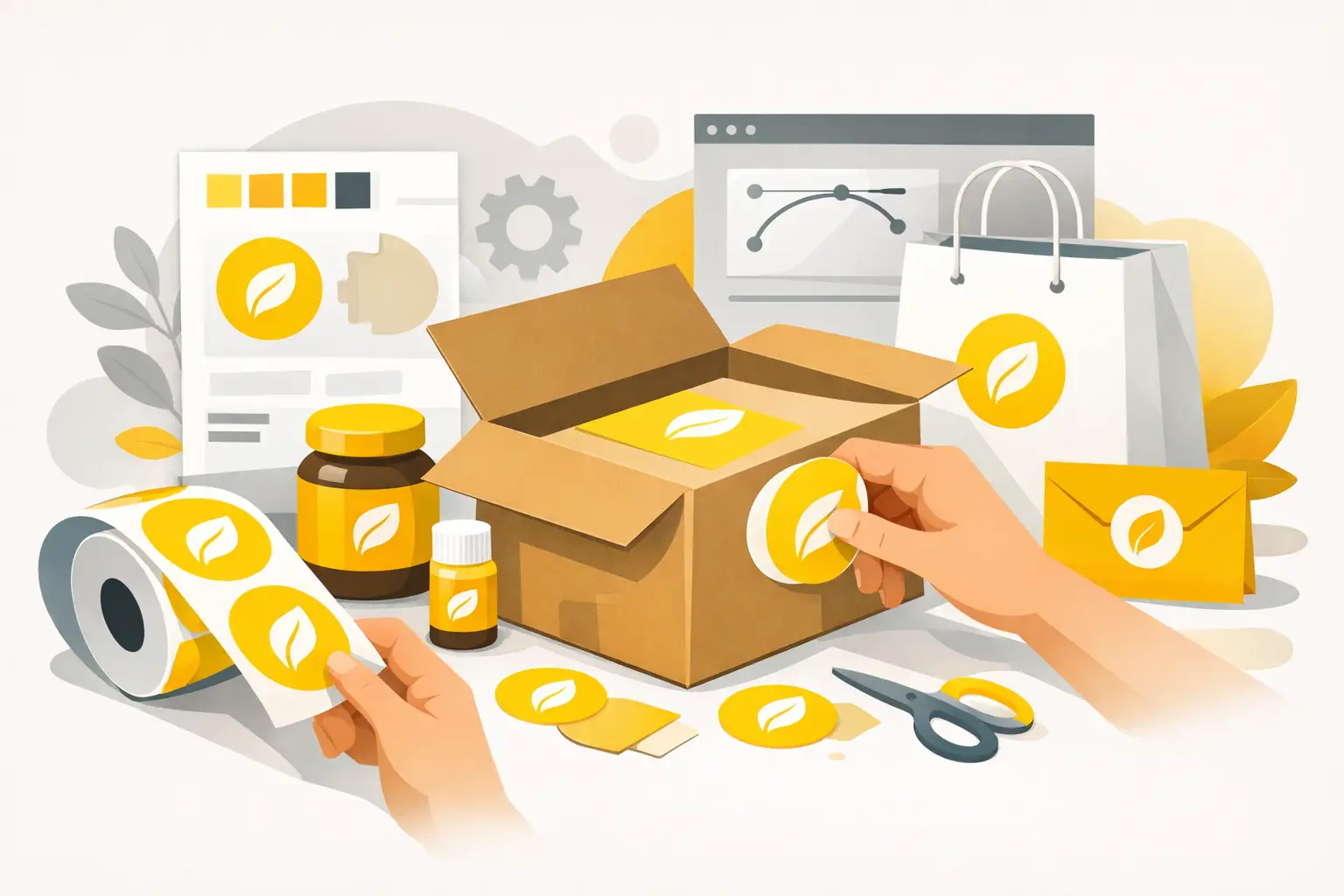
Packaging is often the first physical encounter between a customer and your brand. A precisely sized, clearly readable label does more than seal a box or identify a product: it builds trust, encourages repeat purchases, and creates a unified shelf presence. This guide to branded packaging labels is designed for small businesses, manufacturers, and online shops that want a professional appearance even with low initial order quantities.
What Makes a Good Packaging Label?
A good label must be clear above all else. The customer should understand in seconds what they're buying, who made it, and which variant they're holding. For a jar of honey, this means the flavor and size; for cosmetics, essential information about ingredients or usage; for a webshop shipment, the brand name and a brief, recognizable message.
Second, the label must suit its actual use environment. Paper bags, chilled glass bottles, cosmetic jars, and cardboard boxes for courier delivery don't necessarily need the same material, adhesive, or surface finish. The design may be excellent, but if the label peels off, gets soaked, or scratches easily, the perceived quality of the entire packaging suffers.
Finally, the label must integrate with your production process. If you label hundreds of products daily, it matters how quickly a label strips from the sheet, how precisely it can be applied, and how tolerant it is of slightly curved surfaces. Small batches offer more freedom for custom shapes, while larger volumes often benefit from faster application and uniform sizes.
Starting with Surface Selection
Choose your size and material based on the physical dimensions of your packaging, not just what you see on screen. Measure the flat or slightly curved area where the label will go. Leave a few millimeters of clear space around it, especially for glass, jars, and curved boxes. A label that's too large will wrinkle easily; one that's too small can get lost.
A round label works well on caps, seal stickers, and simple logo communication. A rectangular or rounded-corner format is practical when you need more text, barcodes, or product information. Custom contour cutting strengthens brand recognition, particularly for promotional stickers, gift packaging, or products where the shape itself is part of the visual identity.
Surface cleanliness matters too. A dusty, oily, wet, or heavily textured surface won't hold even a quality label the way a smooth, clean glass, plastic, or lacquered cardboard will. Consider testing a small batch if you're introducing new packaging or if the product will be refrigerated or used in humid environments.
Packaging Type Determines Priority
On cardboard boxes, a matte finish often feels more premium and understated, reflecting less distracting light. For glass, bottles, and outdoor products, durable vinyl is a good starting point because its water-resistant and UV-resistant properties help preserve the appearance.
If your label will experience frequent friction—during shipping or regular handling—lamination provides extra protection against wear and scratching. Glossy finishes can make colors more vibrant, working well for beverages, sweets, or bold brand identities. Matte surfaces feel more refined and are generally easier to read in bright light.
There's no one-size-fits-all winner: your brand identity, packaging material, and intended use must work together. When ordering from getstickerz.eu/#konfigurator, you can experiment with different finishes to see what suits your product best.
Design: Brand Identity Plus Usability
A packaging label isn't a full brochure. If too many elements are crammed on, the customer won't know where to look first. Your logo, product name, or main message should dominate the visual hierarchy. Secondary information—such as flavor, scent, weight, or a brief product benefit—can appear in smaller text but must remain readable.
Always evaluate font size at the final printed scale, not just on screen. A tiny, thin typeface might look elegant digitally but become hard to read when printed, especially on curved surfaces. Similarly, pay attention to contrast: dark text on a light background or light text on a dark background is usually more reliable than two similar tones.
For file preparation, vector formats give the sharpest logos and text, but high-resolution raster graphics also work. For photos and detailed illustrations, proper resolution is especially important. Careful handling of bleeds, safety margins, and cut lines ensures important elements don't end up too close to the edge.
Before uploading, run through these four questions:
- Is the logo and main text readable at the chosen final size?
- Is there enough space between the cut line and important graphic elements?
- Do the colors match your brand identity, with strong enough contrast?
- Does the design include all necessary product information without feeling crowded?
Roll, Kiss-Cut, or Individual Die-Cut?
The format is primarily determined by how you'll use the labels. Roll format is an efficient solution if you're applying labels by hand and need many identical stickers. It stores transparently, handles quickly, and is especially practical for small-scale production.
With kiss-cut labels, the top layer is cut around the perimeter while the backing sheet stays intact. This is a good choice for multiple promotional designs, gift labels, or custom shapes. Individual die-cut labels come as separate pieces, ready for orders, giveaways at events, or inclusion with products. They're a powerful brand-building tool, though for large labeling volumes, roll format is usually faster.
Explore all these options at getstickerz.eu/#termekek to find what works best for your production flow.
Order Quantity and Cost: Look Beyond Unit Price
A common mistake for emerging brands is ordering too large a batch of untested packaging. If you're testing a new flavor, seasonal product, or fresh design, a short run reduces risk. Starting from as few as 10 units can make sense: you can verify size, colors, adhesion, and customer reactions before committing to a larger quantity.
As your order volume grows, planning reliability can be worth more than a few cents of unit-price difference. Think about how many labels you go through in an average month, whether there are seasonal peaks, and if you need inventory for multiple product variants. Clear, distinct filenames and version numbers help prevent old formulations or outdated designs from being reprinted by mistake.
The advantage of an online configurator is that you can see the price immediately based on size, shape, material, and quantity. This enables faster decision-making than requesting lengthy custom quotes, while file review and optional print previews provide additional security before production. Visit getstickerz.eu/#konfigurator to design and order your labels with instant pricing.
At GetStickerz, file checks are completed within 24 hours, which is especially helpful if you're working with tight product launch or reorder deadlines.
Common Mistakes That Drive Up Label Costs
The first mistake is designing without the actual packaging. A flat digital mockup won't show what happens to your graphic on a tapered bottle, a curved lid, or near a fold line. Always apply a sample to real packaging.
The second is giving every piece of information equal emphasis. Customer attention is finite, so the most important message should stand out first.
The third is over-economizing on materials. If your product experiences moisture, refrigeration, or frequent handling, a less durable finish will later cause more waste and relabeling costs. Treat your label as part of the product experience, not as a separate print job.
Best Practices for Success
Choose a size and material that will withstand real-world use. Request a preview if your file or cut shape is uncertain. Start with a small quantity to test before ordering larger batches. This way, your next packaging won't just look better—it will reach your customer faster and with greater confidence.
For questions about your specific project, visit getstickerz.eu/kapcsolat to get in touch with the team, or explore more at getstickerz.eu/rolunk to learn about the company's approach to quality and fast EU production.
A well-designed, properly produced label transforms packaging from a functional necessity into a brand asset. Take the time to get it right, and your customers will notice.