
15/06/2026
Paper or Vinyl Labels? How to Make the Right Choice
The question of paper or vinyl labels usually doesn't come up as a theoretical debate when the finished product is already on the table and the label needs to withstand the refrigerator, moisture, oily surfaces, or shipping. At that point, it doesn't matter which is cheaper at first glance—what matters is which one works reliably in real-world use. If you sell jam, honey, cosmetics, craft beverages, candles, or any packaged product, the material choice directly affects appearance, longevity, and how professional your product remains in the customer's hands. A good decision requires more than knowing that paper looks more natural and vinyl is more durable. The difference comes down to the usage environment, the type of surface, and the expected brand feel.
Paper or Vinyl Labels: What's the Real Difference?
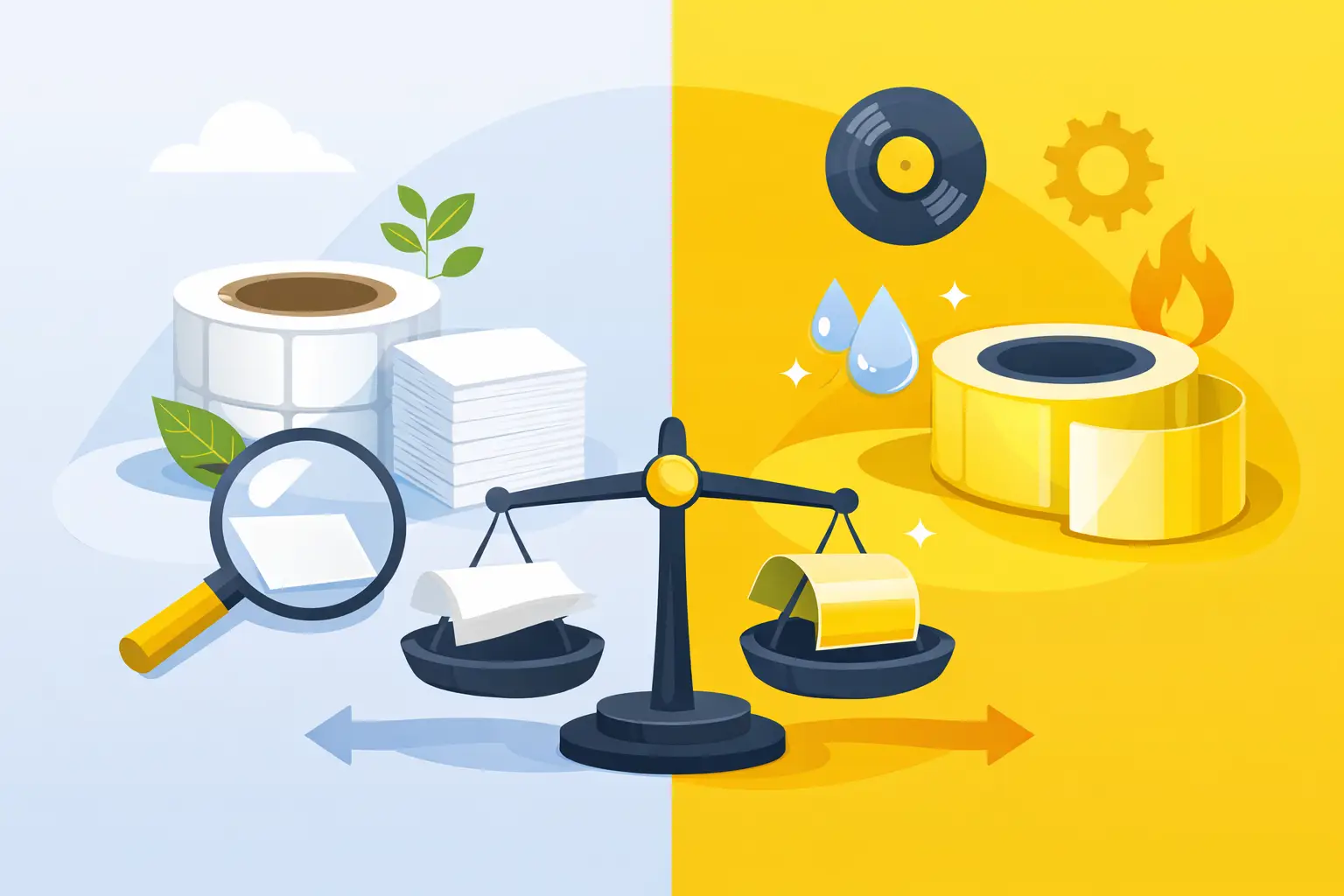
The biggest advantage of paper labels is the price and classic appearance. They work well on many products, especially in dry, indoor environments where there's no sustained moisture, mechanical friction, or temperature fluctuations. A paper base can give a nice handmade, natural, or simpler shelf presence, and for shorter campaigns or promotional stickers, it can be a completely adequate choice.
Vinyl labels, on the other hand, are a more resistant material. They better withstand water, moisture, cold, outdoor environments, and more intensive handling. If a label goes on a bottle, jar, tube, or packaging that's regularly held, wiped down, or shipped, vinyl is usually the safer choice. The surface is more uniform, the print appears more stable, and lamination can provide even further protection.
The short answer, then, is this: if cost is the primary concern and the environment is mild, paper can be good. If durability, moisture resistance, and reliable appearance are important, vinyl is the stronger option.
When Is Paper Label Enough?
Paper labels make sense when the product stays in a dry environment, the packaging doesn't receive much physical stress, and it's not a problem if the material is sensitive to moisture. A typical example might be a boxed product stored indoors, gift packaging, a seasonal promotion, or a short-run series where price sensitivity matters more than long-term resistance.
For craft brands, paper can also be an aesthetic choice. It can look good in a more rustic, natural visual world, especially if the packaging itself reinforces that direction. However, it's worth thinking honestly about what happens on the shelf and in the customer's hands. A jar of honey grabbed with sticky fingers, or a product used in the bathroom, will quickly show the limitations of paper.
Paper labels can be a good choice for sample labeling or for startup brands when the design might still change and only a small batch needs to be tested initially. In these cases, the entry cost might be lower, but long-term, replacement, reordering, or damaged labels don't always make it the most economical path.
Paper labels are also worth considering if you want to test your packaging design before committing to larger quantities. You can explore the configurator at getstickerz.eu/#konfigurator to order small batches affordably.
When Is Vinyl Label Better?
Vinyl labels really start to pay off where the label isn't just decoration but also serves a performance function. For beverage bottles, cosmetic jars, oily or wetter surfaces, refrigerated products, outdoor use, or frequently moved packaging, this is typically the more stable solution.
The advantage of vinyl isn't just that it's more water-resistant. It's also important that it better tolerates scratching, is less prone to wrinkling, and stays aesthetic longer. If you sell through an online store and the packaging goes through multiple logistics points, the condition of the label will be part of the first impression. A curled or stained label immediately damages the brand feel, even if the product itself is excellent.
For premium positioning, vinyl is often the better choice. The smoother surface, cleaner colors, and optional matte or glossy finish can create a more professional overall effect. When combined with lamination, the label becomes even more resistant, which is especially useful for cosmetics, beverages, and promotional stickers.
Paper or Vinyl Labels by Product Type
The decision can be sped up if you think not in terms of materials but in terms of concrete usage.
For honey, syrup, jam, and other glass products, vinyl is often the safer choice, especially if the product might go in the refrigerator or the label will be touched with wet hands. For beer, wine, or soft drink bottles, greater moisture resistance is also an advantage. For cosmetics—such as creamy jars, shampoo bottles, or oil bottles—vinyl is almost always the stronger option. Bathroom humidity and regular contact quickly test the material.
For boxed, dry goods, or indoor-use products, paper may be sufficient if the packaging doesn't encounter water and the label doesn't receive heavy stress. This might be a candle box, an indoor gift package, or a limited promotional series.
For promotional stickers and brand-building stickers, vinyl's advantage is even more striking. If the sticker goes on a laptop, water bottle, car, or packaging, durability quickly becomes the primary concern.
The Surface Matters, Not Just the Material
Many label mistakes don't start at printing but rather at overlooking the surface. A label behaves differently on glass than on cardboard, and again differently on soft-touch plastic or slightly textured packaging. A cylindrical bottle, a small-diameter jar, or a slightly curved surface all affect how well a label adheres.
This is where vinyl's practical advantage comes in. It's more flexible and better handles challenging surfaces, especially when manufactured to precise dimensions and shapes. This doesn't mean it's automatically perfect on every curved surface, but the margin for error is generally smaller than with paper.
If your packaging is new or you don't yet have a manufacturing routine, it's worth testing in smaller quantities. For short runs, this is especially useful because you'll quickly discover how the label performs in real use. Ordering a small batch through an online configurator at getstickerz.eu/#konfigurator is perfect for this—you don't need to think in terms of huge inventory to make a confident decision.
Cost, Durability, and Reordering
Paper labels have a lower initial cost in many cases. This can be attractive, especially for small businesses or startup products. But if the label gets damaged, gets wet, or needs replacing prematurely, the total cost becomes less clear-cut. Vinyl is generally a pricier material, but it less often causes quality compromises.
If your product is premium-priced, if you export, if shelf presence matters a lot, or if the packaging's journey from manufacturer to customer is long, the higher material cost often correlates with lower risk. This is why, from a business perspective, the right question isn't which label is cheapest, but which material causes the fewest problems throughout the entire sales process.
Waste, relabeling, and weaker brand appearance all cost money—they just don't always show up on the same line item.
What Finish Suits Your Chosen Material?
If you opt for vinyl, surface treatment also matters. A glossy finish gives stronger colors and a more vibrant appearance, which is why it's a common choice for beverages, promotional stickers, or attention-grabbing brands. A matte surface is more understated, premium-feeling, and works better on many cosmetic or minimalist packages. Lamination gives the label extra protection against scratches, moisture, and UV exposure.
This isn't necessary for every project, but for outdoor use or more intensive stress, it's definitely justified. If the goal is longer lifespan and consistent appearance, it's worth factoring in at order time.
Precise size and shape are at least as important. A well-designed round, oval, or custom contour-cut label improves the overall effect more than many realize. Good material alone can't save a poorly fitting label.
Paper or Vinyl Label: How to Decide Quickly?
If the label encounters water, moisture, cold, oil, or frequent contact, choose vinyl. If you use it in a dry, protected environment and price is the primary concern, paper may be adequate. If you want a premium appearance and longer-term reliability, vinyl offers a more confident answer in more situations.
The best decision typically doesn't come from a general rule but from precisely seeing your product's path. Where will it be stored, how will it be shipped, how often will it be handled, how long will it stay in circulation, and what impression does it need to make at first glance? Honest answers to these questions will quickly reveal whether paper or vinyl labels fit the job better.
If you're uncertain, don't just look at the design—also look at the usage environment. Visit getstickerz.eu/#termekek to explore the range of available materials and finishes, or check getstickerz.eu/rolunk to learn more about how we approach label selection.
A well-chosen label isn't a separate project alongside your product—it's one of the most important functional elements of your packaging.