15/10/2026
Premium Sticker Printing in Small Batches Too
Condensation on a honey label, a fingernail scratch on a delivery box, or an outdoor promotional sticker in strong sunlight—these are the moments that reveal what premium sticker printing really means. A good sticker doesn't just look nice on screen. With accurate colors, clean contours, and durability suited to its use, it represents your brand on every single applied piece. For small businesses, artisan manufacturers, and online shops, the sticker is often the most visible brand element on packaging. With custom shapes, the right surface, and reliable adhesion, it can simultaneously serve as a product label, package seal, logo sticker, or promotional tool. The decision therefore isn't just about the graphic: the material, execution, and ordering process also affect the end result.
What Makes Sticker Printing Premium?
The term "premium" should translate into measurable properties in practice. This includes detail-rich prints, stable color reproduction, consistent cutting, and a base material that doesn't quickly lose its appearance during intended use. A low-quality paper sticker might work fine indoors for a short time, but on a refrigerated beverage bottle or cosmetic jar it will quickly curl, become waterlogged, or wear away. Vinyl-based stickers are often a safer choice. They're water-resistant, more flexible, and with proper manufacturing also provide UV resistance. This is particularly relevant if the product goes in the refrigerator, gets exposed to moisture during shipping, or the sticker ends up in shop windows, on vehicles, or outdoor equipment. Durability, however, always depends on the surface and conditions of use. On dusty, oily, or heavily textured surfaces, even the best material won't adhere the same way as on clean, smooth packaging.
The other part of quality is cutting. Custom contour-cut stickers can follow the outline of a logo, illustration, or distinctive product shape. This can make the result more professional and memorable than a simple rectangle. If quick application or many small graphics are more important, curved kiss-cut execution is more practical: the sticker is cut in a circle, but the carrier sheet remains intact.
Material and Surface: This Determines Usability
The difference between glossy and matte vinyl isn't merely aesthetic. The glossy surface brings out saturated colors more vividly, so it's often a good choice for beverages, gift packaging, or high-contrast promotional graphics. The matte surface has a more restrained, premium appearance and reflects less light. For cosmetic brands, artisan products, or minimalist identities, this often fits the packaging better.
Lamination provides additional protection for the print. It can help reduce scratching, moisture, and marks from frequent handling, so it may be worthwhile for stickers intended for water bottles, laptops, toolboxes, or frequently-handled product packaging. It's not always necessary. For indoor, short-term campaigns or one-time package seals, a non-laminated solution might be sufficient. If, however, the sticker remains continuously visible throughout the product's lifecycle, the extra protection is usually justified.
It's worth considering the moment of application too. A label with rounded corners is less likely to start peeling at the edges than one with sharp corners. For a label going on glass, the exact size matters alongside the bottle's curve. If the sticker is too large, wrinkles or tension may appear, which damages both the overall look and adhesion.
Premium Sticker Printing in the Right Format
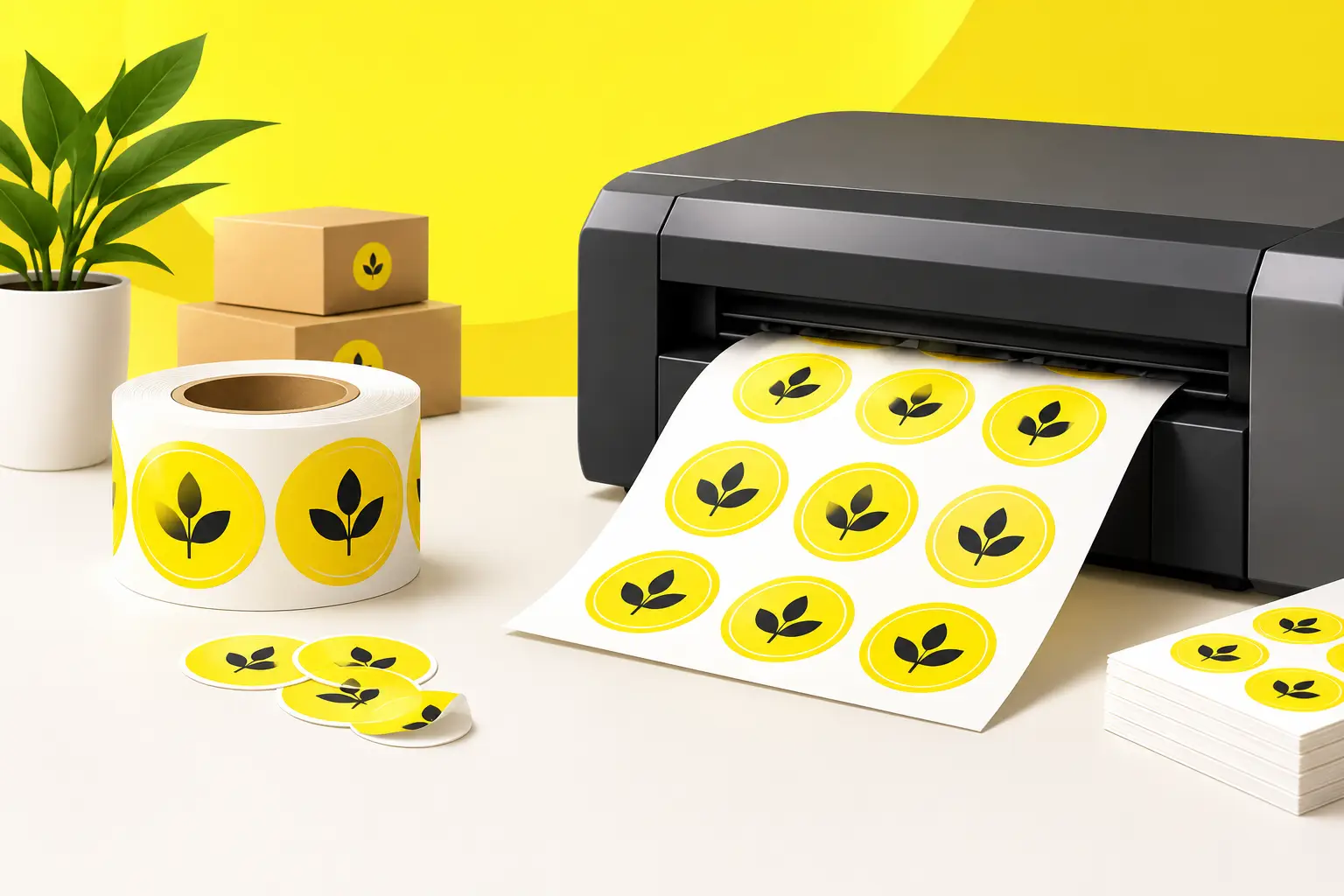
When choosing the format, both brand experience and workflow matter. Individually contour-cut, separate stickers work well at events, alongside shipments, or for reseller promotions. They're easy to distribute, and customers are more willing to use them on personal items. Labeling might have different priorities. If a producer is labeling dozens or hundreds of bottles of honey, sauce, or cosmetics, stickers placed on sheets can speed up manual application. Here, size accuracy, consistent positioning, and easy separation are what matter most.
Even the most beautiful shape isn't ideal if it slows down packaging or is difficult to apply to the product. Always check the size in a real environment. Print a trial piece on normal paper, cut it out, and then apply it to the box, bottle, or bag. This simple step shows whether the logo is large enough, the text remains readable, and there's room for required product information. A graphic that looks proportional on screen can make quite a different impression on a 50-millimeter label.
Print-Ready File: Less Risk, Better Results
The foundation of premium execution is a good graphic file. A vector logo, properly resolved image, and clean cutting line help keep the print sharp. For small labels in particular, it's crucial that text size isn't too small and thin lines don't disappear. Overstuffed designs often don't look weak because of printing, but because they're trying to communicate too much information for the available space.
Bleed is also essential. If the background color or graphic extends to the edge of the sticker, the design must continue beyond the cutting line. This way, even accounting for manufacturing tolerances, no distracting white border appears. Equally important is safety distance: text, logos, and important details shouldn't be placed directly next to the cutting contour.
An online configurator like the one at getstickerz.eu/#konfigurator can provide quick quotes based on size, quantity, material, and execution, but pre-production review still holds value. GetStickerz's 24-hour file check serves to catch basic production issues before printing begins. For uncertain graphics, a new brand identity, or higher-value orders, print preview approval provides additional control.
Visit getstickerz.eu/#termekek to explore the available options and customize your order.
Consistency is Possible Even with Small Batches
Small series orders are particularly useful for startup brands and seasonal products. You don't need to keep thousands of units in stock for packaging to be uniform. From just ten pieces, you can test a new label size, a limited flavor, or a campaign graphic. If the product performs well, the proven settings can easily be scaled up later. This flexibility also reduces the cost of errors. For a new color palette, revised ingredient list, or updated logo, it's worth ordering first in smaller quantities.
A sticker seen on the actual product is a far more reliable decision-making basis than a design mockup approved on screen.
Before You Order
So before placing an order, don't just ask what the sticker should look like, but also where, for how long, and under what conditions it will need to perform. If these three answers are clear, selecting the material, surface, format, and quantity becomes easier—and the applied sticker will truly convey the quality you've invested in the product.
For more information or to start your order, visit getstickerz.eu/rolunk or reach out through getstickerz.eu/kapcsolat with any questions about your specific needs.